
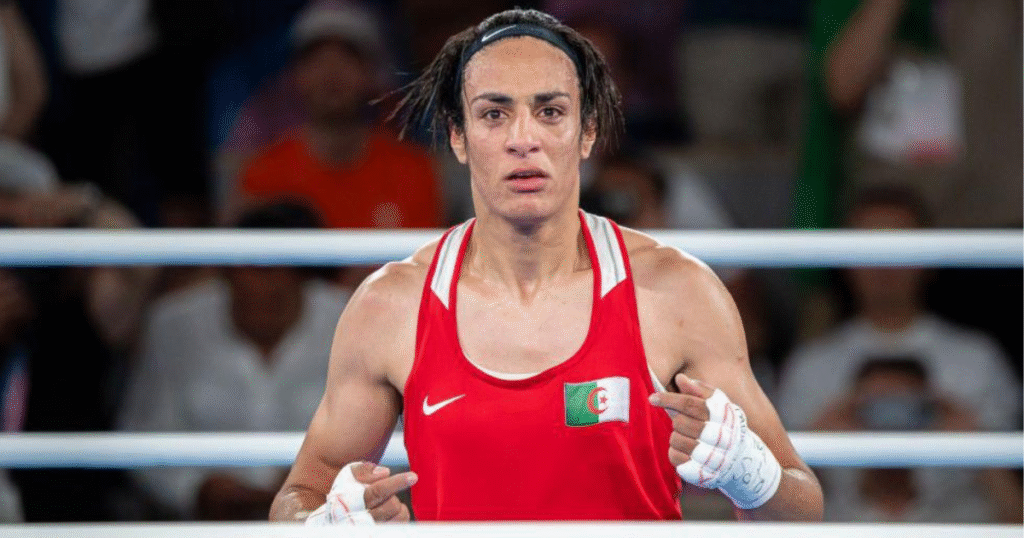
Imane Khelif, the 2024 Olympic women’s welterweight boxing champion from Algeria, has announced her intention to return to competition and defend her gold medal at the 2028 Games. Her decision comes amid an ongoing controversy surrounding gender eligibility in women’s boxing, raising questions about fairness, safety, and privacy in elite sport.

Imane Khelif was born on May 2, 1999, in Aïn Sidi Ali, Laghouat Province, Algeria. Khelif, as far as we are aware, was born female and registered at birth as that sex. However, speculations have arisen over her gender as some reports suggest she may have the male XY chromosome. Yet, things are not always black and white. Rare conditions, such as differences of sexual development (DSD) and intersex traits, make biological sex more complex than a simple binary classification.
Furthermore, while this is a very grey area, it is important to balance two principles. Athletes should not be discriminated against because of their biology, but at the same time, sport must remain safe and fair, particularly in physically demanding disciplines like boxing where an unfair advantage could endanger other competitors or compromise competition integrity. Khelif’s situation exemplifies this tension between inclusivity and fairness in sport.

SHOP HERE : Kickboxing Equipment
Khelif first rose to prominence at the 2024 Paris Olympics, winning gold in the women’s 66 kg category. Before that, she was disqualified from the 2023 World Championships by the International Boxing Association (IBA) after failing a gender-eligibility test. When the IBA lost Olympic recognition, the International Olympic Committee cleared her to compete in Paris based on her passport and long history of competing as a female athlete.
Despite her Olympic success, controversy resurfaced after a leaked report suggested Khelif might have male biological characteristics. In response, World Boxing introduced mandatory genetic sex testing for all female competitors over 18, effectively barring Khelif from competition unless she complies. Khelif has publicly denied being transgender, insisting she was born female and has lived her entire life as a woman, and has appealed the testing requirement at the Court of Arbitration for Sport.
The debate surrounding Khelif’s return highlights two perspectives. Advocates for testing argue that ensuring fairness and safety in a contact sport is essential. Opponents emphasize that there is no verified public evidence of an unfair advantage and that forcing genetic tests could violate privacy and risk discrimination.
Imane Khelif has the right to defend her title, but it should be under fair and transparent conditions. Eligibility standards should ensure safety and fairness while respecting athletes’ privacy. The resolution of this case may set an important precedent for how similar situations are handled in women’s sports in the future.
Final verdict: Khelif should be allowed to compete if she meets scientifically valid eligibility criteria.