
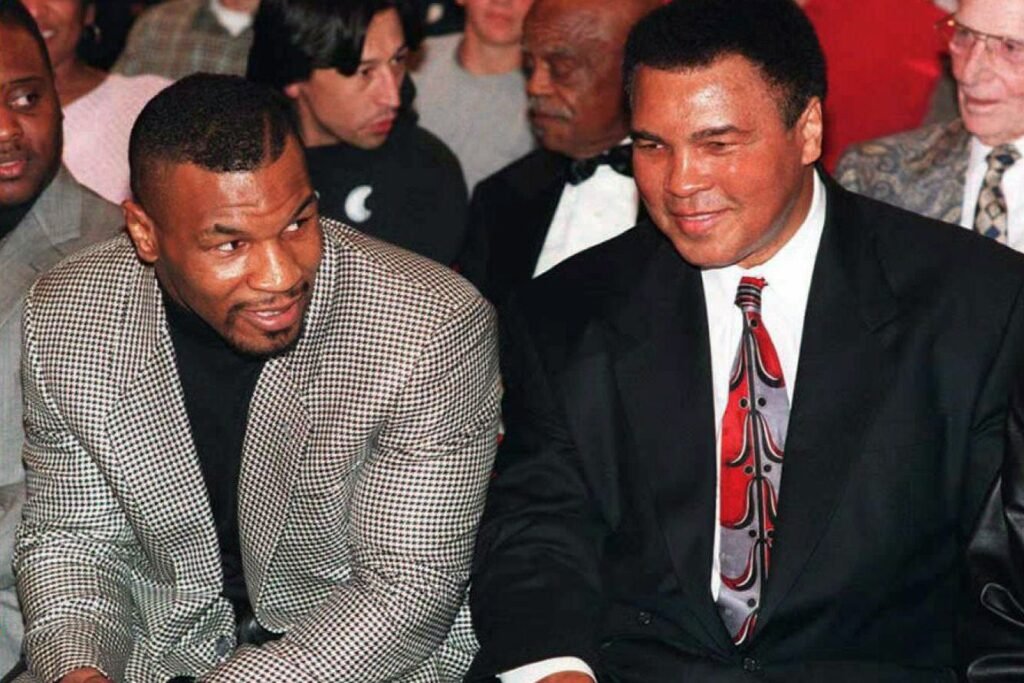
Few hypothetical fights in boxing history spark as much debate as Mike Tyson vs Muhammad Ali. Both heavyweight legends dominated their respective eras, but their contrasting styles make a prime-versus-prime showdown one of the most fascinating matchups the sport never got to witness.
Tyson was an explosive knockout artist who could overwhelm opponents before they had time to settle into a fight. Ali, meanwhile, combined extraordinary hand speed, footwork, ring intelligence and stamina to outbox some of the greatest heavyweights in history.
But if both men entered the ring at the absolute peak of their powers, who would come out on top?
Tyson’s prime is generally associated with the late 1980s, when he became the youngest heavyweight champion in boxing history at just 20 years old. Trained by Cus D’Amato, he developed a devastating style built around head movement, explosive combinations and relentless pressure.
Tyson did not simply rely on raw punching power. His ability to slip punches while moving forward allowed him to close the distance and unleash hooks and uppercuts from dangerous angles. His 91-second knockout of Michael Spinks in 1988 remains one of the defining performances of his career.

SHOP: Kickboxing Equipment
Against Ali, Tyson’s greatest opportunity would be to get inside the reach of his taller opponent and attack the body before unleashing combinations upstairs. If he could trap Ali against the ropes and land cleanly, his knockout power would make him dangerous at any moment.
Ali, however, possessed the tools to make that task extremely difficult.
During his first prime in the 1960s, Ali showcased remarkable movement for a heavyweight. His quick jab, reflexes and ability to change angles allowed him to frustrate opponents who struggled to establish their preferred range.
Standing approximately 6 feet 3 inches tall, Ali also had a significant height advantage over Tyson, who stood around 5 feet 10 inches. That difference could become crucial if Ali maintained distance and forced Tyson to repeatedly work his way inside.
Ali’s durability would also be a major factor. He endured punishing fights against elite heavyweights, including Joe Frazier and George Foreman, while demonstrating an ability to adapt his approach depending on his opponent.
Tyson’s early aggression could certainly trouble Ali, but the longer the fight continued, the more opportunities the former champion would have to use his experience and movement.
The opening rounds would likely be the most dangerous period for Ali.
Tyson would attempt to cut off the ring, attack the body and prevent Ali from establishing a rhythm with his jab. Rather than allowing Ali to circle freely, Tyson would need to close the distance intelligently and make every exchange count.
Ali’s challenge would be to avoid prolonged exchanges at close range. He could use his jab to disrupt Tyson’s entries, move laterally and clinch when necessary to prevent the younger heavyweight from unleashing combinations.
However, it would be a mistake to assume Ali could simply dance away from Tyson for the entire fight. Tyson was an accomplished pressure fighter whose head movement and footwork made him much more sophisticated than a conventional knockout puncher.
The turning point could arrive around the middle rounds. If Tyson had not secured a decisive advantage early, Ali’s movement, combination punching and experience over longer fights could begin to tell.
Ali was also capable of fighting aggressively when necessary, meaning Tyson would have to remain defensively responsible even when pressing forward.
There is no definitive answer to this hypothetical matchup, and the outcome would depend heavily on the rules, ring size and which versions of the fighters were used. Nevertheless, the stylistic contrast provides a compelling case for both men.
Tyson would have a genuine chance of stopping Ali during the early rounds. His explosive combinations and ability to attack the body could create problems even for a fighter as gifted as Ali.
However, Ali’s reach, movement, stamina and adaptability give him a strong argument over a full championship-distance contest. His ability to frustrate aggressive opponents and adjust during difficult fights could allow him to take control as the bout progresses.
Tyson’s power means he could never be counted out, but Ali’s skill set appears particularly well suited to making the younger heavyweight work for every opening.
Final prediction: Muhammad Ali wins by unanimous decision after 12 rounds, with Mike Tyson remaining a serious knockout threat in the early stages.
READ MORE: Luo Chao Promises Victory Over Childhood Hero Marat Grigorian