
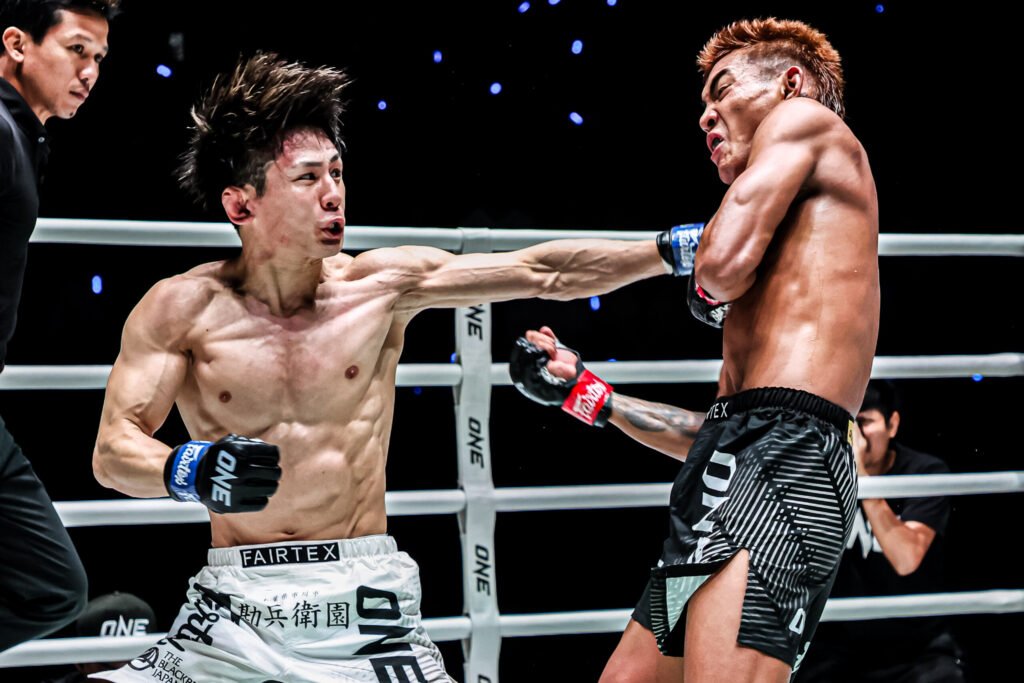
Fear reveals itself differently in childhood than competition, and Ryohei Kurosawa experienced both versions before building the confidence carrying him into Friday’s clash with Bokang Masunyane at ONE Fight Night 39: Rambolek vs. Dayakaev on Prime Video. The Japanese striker brings a 20-4 record and six consecutive victories to Lumpinee Stadium, yet remembers vividly when simply standing in a room with strangers paralyzed him with anxiety.
That transformation from terrified five-year-old to composed finisher defines Kurosawa’s entire journey. His parents introduced him to shotokan karate in Matsudo, Chiba, where his father’s love for martial arts created an environment where combat sports felt natural. The techniques never frightened young Kurosawa — sharing space with other students did.
“I won’t lie, I was a bit scared of it,” Kurosawa recalled. “I wasn’t scared [of training]. But I was mostly scared of being in a room with other students. I’ve never shared that kind of space with other people before, and maybe that’s why I was really scared about it.”
His father recognized potential others might have missed. Working as a mail carrier while training at a local gym and watching MMA broadcasts whenever possible, the elder Kurosawa understood his son possessed gifts worth developing despite the social anxiety. His parents’ relentless work ethic — his father delivering mail, his mother providing care services — shaped everything about how Kurosawa approached his craft.
“My parents were hard workers,” Kurosawa explained. “And I used to be so inspired by them, even as a kid, seeing my parents work so hard. So, that’s why I grew up like this…with the same discipline, focus, and confidence in my job.”
Discovering Blackbelt Japan near his home at 17 changed everything. Within a year, teammates recognized Kurosawa possessed necessary skills for competition. His amateur debut exposed vulnerabilities, facing someone with devastating power created discomfort karate sparring never produced. But that nervous points-victory sparked something irreversible. Ten amateur fights followed, each building confidence until professional competition beckoned in mid-2012.
Turning professional forced honest self-assessment. His karate background created striking advantages, but opponents identified predictable patterns. Whenever facing takedown attempts, Kurosawa defended and returned to striking, always the same response creating exploitable tendencies.

“When I first started, given that my background was karate, I only used to focus on striking,” Kurosawa acknowledged. “But I started building my grappling so I could grapple with opponents. So, I continued to understand and improve as a fighter. Now, I’d say my style is more well-rounded.”
That evolution transformed him into legitimate finisher. His record includes eight knockouts and three submissions, earning both the Shooto Flyweight Title and Pancrase Strawweight Championship. Around his 15th fight, a 24-second knockout via overhand right revealed power he hadn’t fully recognized.
Four losses taught painful lessons, none sharper than his defeat against Jo Arai. That setback exposed weaknesses requiring immediate attention.
“It was my most painful defeat as I lost badly that night,” Kurosawa reflected. “I learned a lot. Every career setback was necessary because it helped me improve as a fighter.”
Those adjustments produced six consecutive victories, culminating in September’s promotional debut against Jayson Miralpez. Friday’s matchup with Masunyane represents another opportunity proving Japanese fighters belong among the world’s elite.
“It’s my chance to show who Japanese fighters are, and it’s my opportunity to prove that Japanese fighters are the best in the world,” Kurosawa concluded.
READ MORE: Reug Reug Introduces IShowSpeed to Senegalese Wrestling Tradition